
Monthly archive series: November 2025. Written and first published in October 2026.
A flex room becomes easier to understand when its photograph communicates one plausible use. A room containing a desk, exercise bike, guest bed, storage shelves and laundry may be perfectly functional for its occupants, yet visually confusing to someone seeing it for the first time.
For listing photography, choose a clear arrangement that respects the room’s actual features. A suggested use can help buyers evaluate possibilities, but it should not turn furniture placement into a claim about approved use, dimensions or what will fit after a move.
Choose the most readable current function
Discuss the room with the agent and decide which use can be shown honestly with the existing arrangement. A simple workspace, reading room or guest area may be easier to understand than several activities at once. Store unrelated movable belongings where practical, without hiding important property conditions.
You do not need to buy furniture to create a theme. Often the useful work is subtraction: remove boxes, straighten the desk and reveal the window and doorway. If the room is empty, consider whether an unmodified photograph and a clear floor plan already explain it adequately.
Show the features that support the use
For a workspace, the viewer may want to understand the available wall space, natural light and relationship to the rest of the home. A desk alone does not answer those questions. Ask for a view that shows the room’s proportions and connections, with a second angle only if it adds information.
Do not claim that the room is soundproof, has special electrical capacity or supports a particular business activity unless that information is verified independently. A photograph can show a door, window or visible built-in. It cannot certify performance or permitted use.
Clear the working life from the work surface
Put away documents, client information, account details and visible passwords. Turn off unnecessary screens and check reflections in glass or glossy surfaces. Store loose cables and accessories safely without disconnecting essential equipment in a way that disrupts the household.
Keep a few purposeful objects if they help explain the arrangement, but avoid filling the desk with staged paperwork. The goal is a usable surface and a clear room, not a fictional workday. Personal or confidential information should not be used as decoration.
Keep room labels consistent
Use the name approved for the listing across captions, description and floor plan. A room described as an office in one place and an additional bedroom elsewhere creates uncertainty. The agent should verify any bedroom or occupancy claim through the appropriate property information rather than the presence of a bed.
If the space supports several possibilities, explain them as possibilities. Phrases such as shown here as a workspace can be useful when accurate. Avoid suggesting that one arrangement guarantees suitability for every buyer’s furniture, equipment or daily routine.
Consider a plan before adding more decoration
An awkward shape or position in the home may be better explained by a floor plan than by more props. Buyers may need to know whether the room is beside the entrance, reached through another room or on a separate level. Those relationships can influence how they would use it.
Our guide to combining photographs and a floor plan shows how appearance and arrangement can work together. If virtual staging is selected for an empty room, retain the original and clearly identify the edited illustration.
Review the final image without its caption first. Can a viewer recognize the proposed function and see the important architectural features? Then read the caption and description together. They should clarify the room without overstating it. A useful flex-room presentation leaves buyers with an understandable space and room for their own decisions, rather than an unsupported promise about everything the room could become.
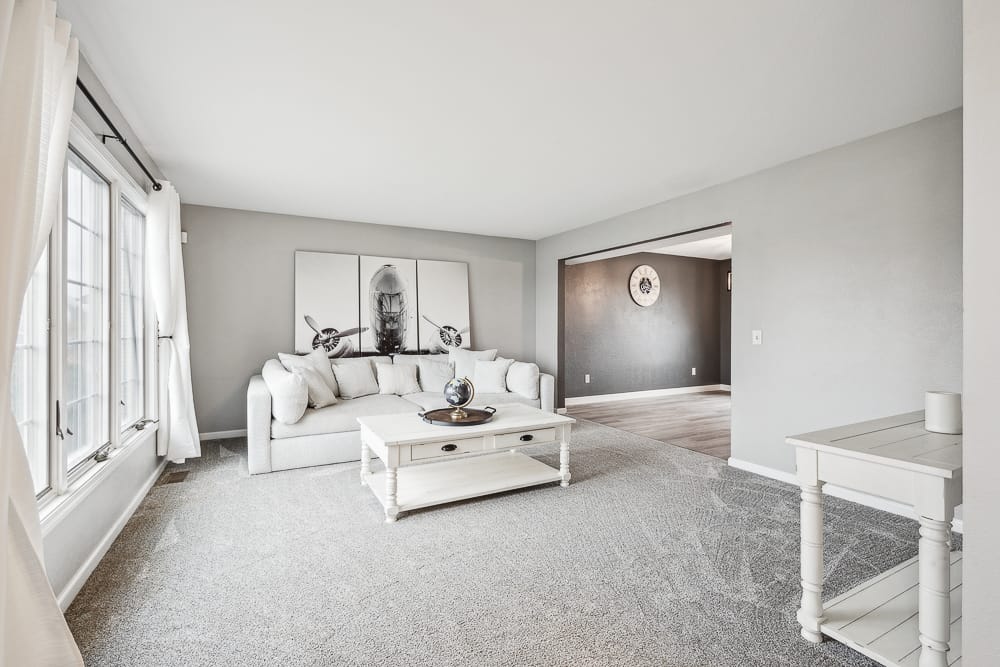
Photograph from the TREM419 property media library, used to illustrate this guide.